Why SMC2 Structures are a Sustainable response to climate challenges
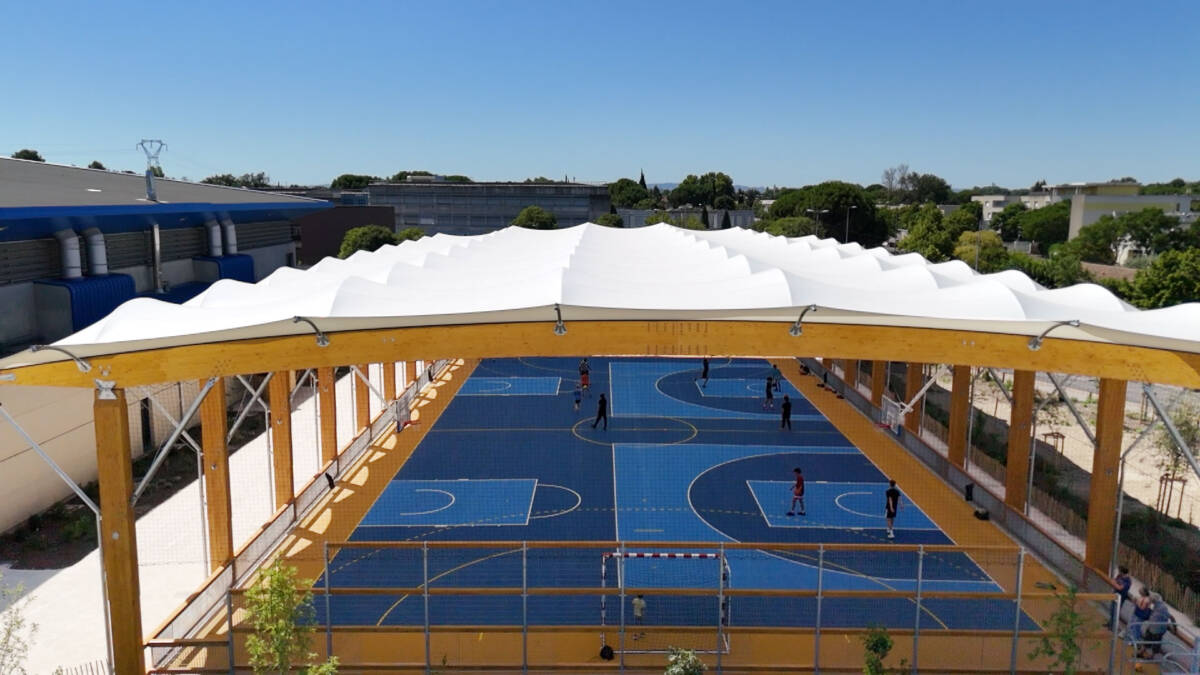
In the face of climate change, the construction industry today must meet a dual challenge: reducing its environmental impact while creating spaces that are better able to withstand the effects of global warming.
At SMC2, this approach has guided the design of our sports, school, and recreational facilities for many years.
Building Differently to Meet Tomorrow’s Challenges
Our construction system, combining wood framing and textile membranes, fulfills the goal of more sustainable construction by balancing environmental performance, user comfort, and longevity.
Beyond simply reducing CO₂ emissions, our structures help create spaces that are more pleasant to live in, better adapted to extreme heat, and designed to serve their intended purposes for decades to come.
Low-Carbon Construction thanks to timber frame
Material selection is one of the key factors in reducing a building’s carbon footprint.
Wood, used as the primary structural material in SMC2 projects, is a renewable resource capable of naturally storing the carbon absorbed during tree growth. This carbon sequestration capacity significantly reduces the embodied carbon of the structure.
A comparative study conducted on a gymnasium in Oswestry (United Kingdom) perfectly illustrates this advantage. By comparing a steel structure to a glued- laminated timber structure, the carbon footprint of the construction phase drops from 730 tCO₂e to just 148 tCO₂e—a savings of 538 metric tons of CO₂. This reduction is equivalent to 1,353 barrels of oil left in the ground.
Cooling Cities with Textile Membranes
Reducing emissions is no longer enough. Cities must also adapt to increasingly frequent heat waves.
SMC2 structures contribute to this adaptation thanks to their textile membrane construction. This membrane reflects a significant portion of solar radiation due to its high reflectivity (albedo effect), thereby limiting heat buildup. Unlike dark surfaces, it absorbs much less solar energy.
Furthermore, the textile membrane offers another major advantage: its translucency.
By allowing uniform natural light to diffuse inside the structures, it improves visual comfort while reducing the need for artificial lighting during the day.
In practical terms, what difference does this construction system make?
When comparing two equivalent projects—one with a wood structure and textile roofing, the other with a steel structure and steel roofing—the difference is clear. During the production phase of construction materials (A1–A3 only), the metal building’s carbon footprint amounts to 45 metric tons of CO2 equivalent, whereas the wood structure stores the equivalent of 15 metric tons of CO2 equivalent over the structure’s lifespan.
A comparison between two solutions that nevertheless both serve the same primary function: protecting athletes and allowing them to practice their sport year-round. So, given that the solutions are equivalent, isn’t it better to choose the one that’s more environmentally friendly?
Sustainable design throughout the entire life cycle
Sustainable construction also means preserving existing ecosystems.
Thanks to a limited footprint and foundations adapted to the specific conditions of each site (micropiles or screw piles, depending on the project), SMC2 structures minimize earthwork and land development.
Depending on the context, buildings can also incorporate green facades or be part of projects that promote the de-impermeabilization of urban and school grounds.
Building less, but building better, is now one of the most effective ways to sustainably
reduce the sector’s environmental impact.
Because today’s infrastructure will shape the cities of tomorrow, we design structures capable of simultaneously addressing environmental issues, user expectations, and global climate challenges.
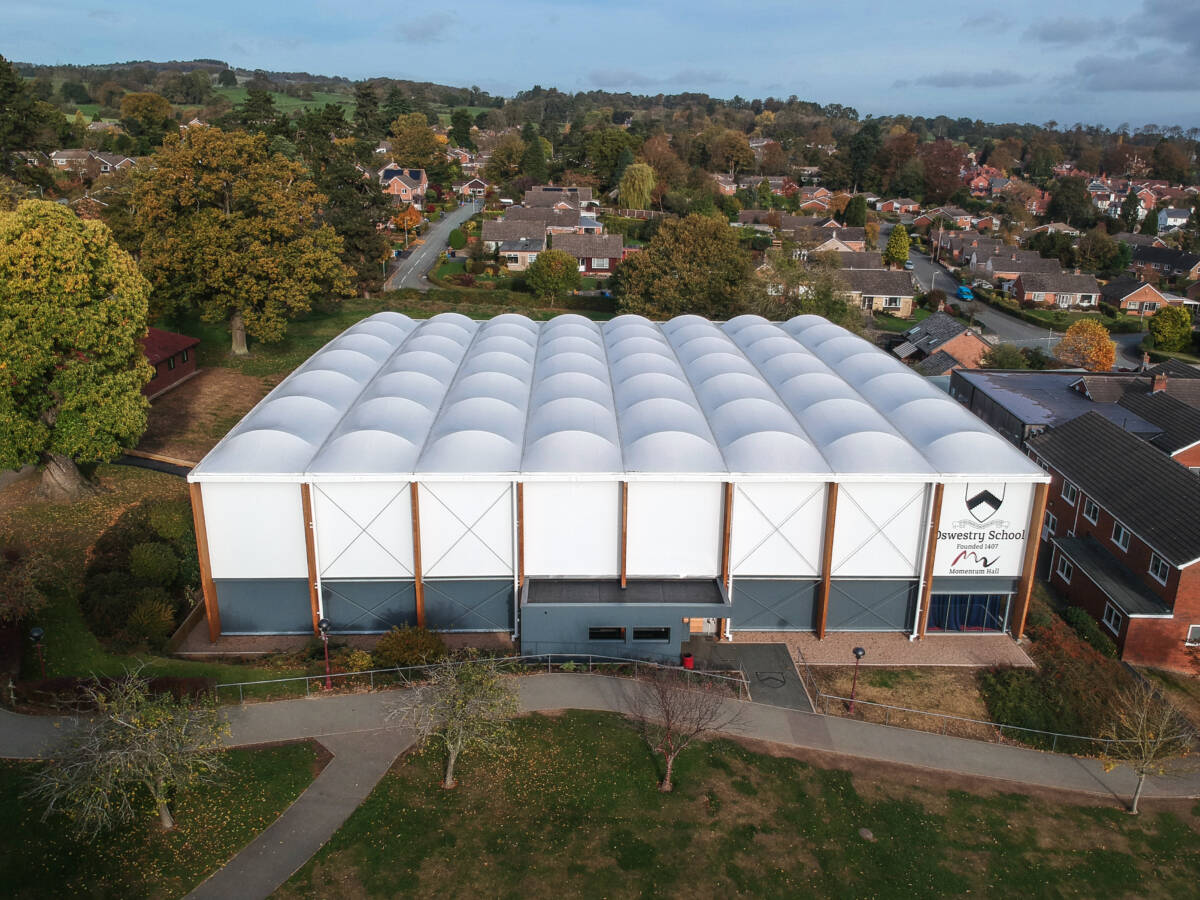
Oswestry School, Site Entrance, 32,Maselfield, Oswestry, SW11 1SB – UK
© Steve Jetley / Andia.fr